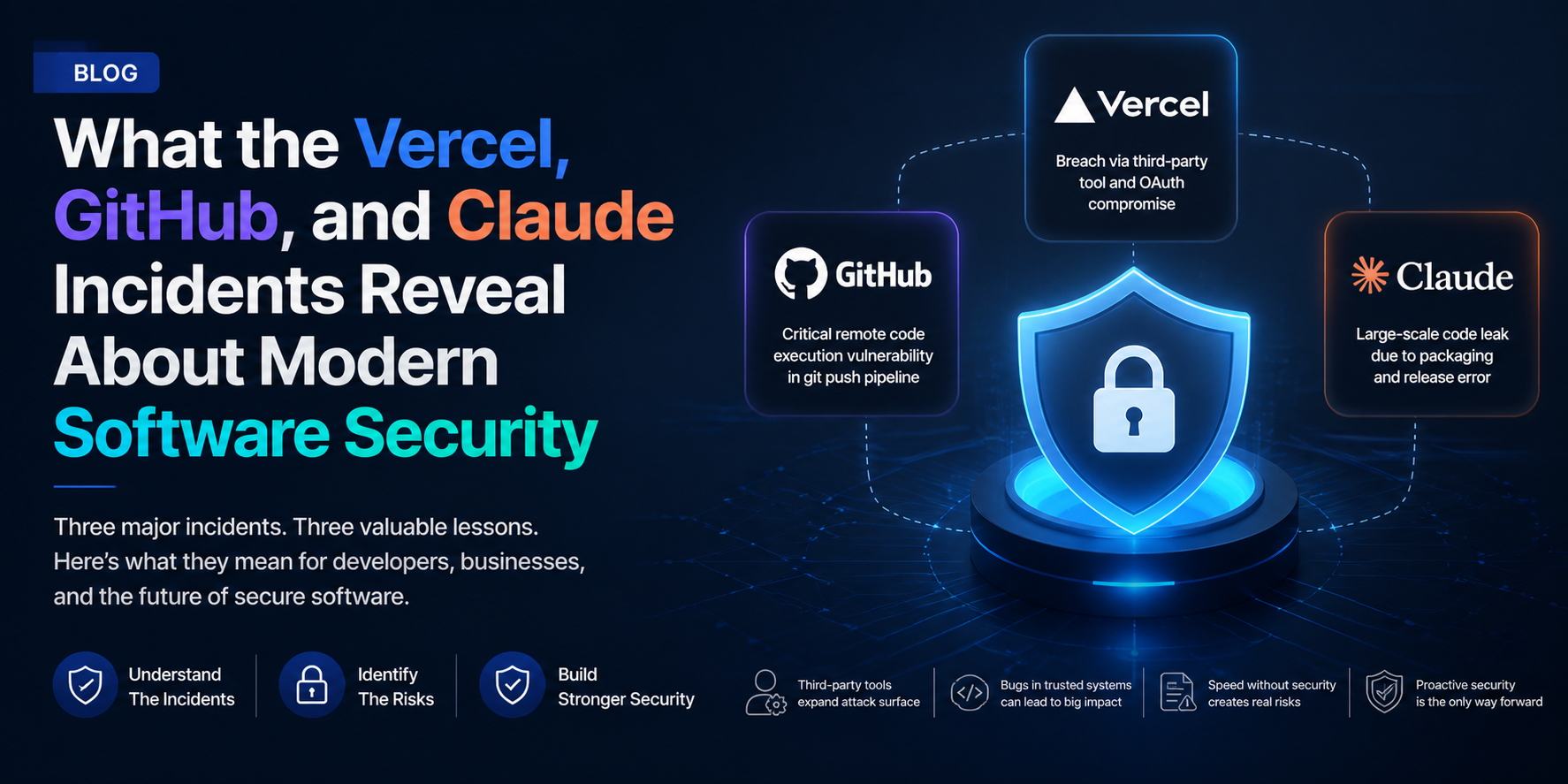
In 2026, the software industry is facing a new kind of security reality. Within a short span of time, major platforms like Vercel, GitHub and Anthropic have all reported serious security incidents. These were not random bugs or isolated failures. Instead, they highlight a deeper issue in modern software development increasing complexity, heavy reliance on integrations and the rapid adoption of AI tools without equally strong security practices. Understanding what happened in each case is important, but even more critical is learning how to prevent similar issues in the future.
GitHub: Critical Remote Code Execution Vulnerability
GitHub discovered a critical remote code execution (RCE) vulnerability that allowed attackers with basic repository access to run arbitrary commands on GitHub’s servers. The issue originated from how git push options were handled internally. User supplied input was not properly sanitized before being passed through internal services. This allowed attackers to manipulate metadata, bypass sandbox protections and execute commands in unintended environments. Although the vulnerability was quickly identified and fixed within hours, it exposed a fundamental weakness: Even trusted internal systems can become attack vectors if input validation is weak.
Vercel: Breach Through a Third-Party AI Tool
In the case of Vercel, the security incident did not originate within their core system but through a third-party AI tool used by an employee. The attacker compromised the external tool, gained access to the employee’s Google account via OAuth, and then used that access to enter Vercel’s internal environment. From there, they were able to retrieve certain environment variables and move across systems. This incident highlights a growing risk in modern development: Your security is no longer defined by your own code, but by every tool and integration connected to your ecosystem.
Claude (Anthropic): AI Code Leak and Distribution Risk
The third case involved Claude, developed by Anthropic, where a large portion of source code was accidentally leaked. Unlike the other incidents, this was not caused by an external attack but by a release and packaging mistake. However, the consequences were still severe, as the leaked code was quickly picked up and used by malicious actors to distribute malware. This reflects a different but equally important issue: Speed in AI development is outpacing secure release practices.
How to Avoid These Security Failures
These incidents may differ in execution, but the lessons they offer are consistent. To build secure software in 2026, companies must adopt stronger, more proactive security practices.
- Strict input validation should be enforced across all systems especially in internal pipelines where assumptions of trust often exist.
- Third-party tools and AI integrations must be audited carefully. Limit OAuth permissions, monitor access logs and avoid giving external tools unnecessary control over critical systems.
- Environment variables and sensitive data should always be treated as high risk assets. This includes encrypting them, restricting access and rotating credentials regularly.
Additionally, organizations should implement defense-in-depth strategies, ensuring that even if one layer is compromised, multiple safeguards prevent full system access. Finally, teams must adopt a “assume breach” mindset. Instead of believing systems are secure, companies should design infrastructure in a way that limits damage even if an intrusion occurs.