Over the last few years, artificial intelligence has evolved at an incredible pace. Every major technology company has been competing to build larger models, faster systems, and smarter AI products. Businesses rushed to integrate AI into applications, automate workflows, and launch AI-powered platforms to stay competitive.
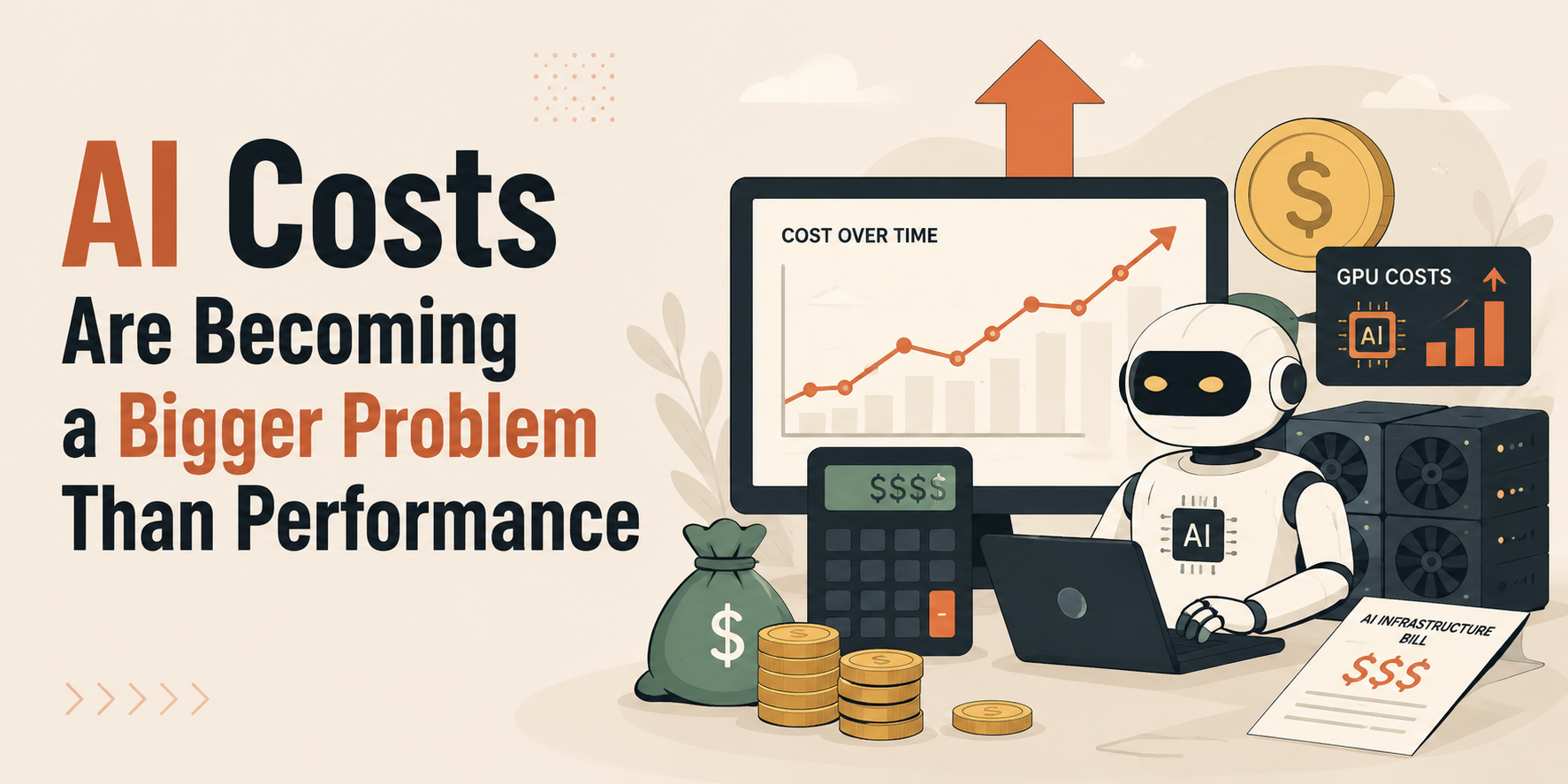
But in 2026, the focus is beginning to shift. The biggest challenge companies face today is no longer whether AI can perform complex tasks. Modern AI systems are already capable of generating code, analyzing data, automating workflows, and interacting like humans. Instead, organizations are now struggling with a different problem the rising cost of running AI at scale.
From GPU shortages and infrastructure expenses to API pricing and operational overhead, AI is becoming increasingly expensive to deploy, maintain, and scale in production environments. The industry is moving from asking, “Can AI do this?” to asking, “Can we afford to run this efficiently?”
Why AI Costs Are Rising So Quickly
The rapid growth of AI has created enormous pressure on infrastructure and computing resources. Modern AI systems require high-performance GPUs, massive cloud infrastructure, continuous model training, large-scale data processing, and significant energy consumption.
Unlike traditional software applications, AI systems consume heavy computational resources every time they process requests. As businesses scale usage across thousands or millions of users, infrastructure costs rise dramatically. Many companies that initially adopted AI expecting long-term savings are now discovering that operational expenses can quickly exceed expectations. This shift is forcing organizations to rethink how AI should be deployed, optimized, and maintained in production environments.
GPUs Have Become the New Gold Rush
One of the biggest drivers behind rising AI costs is the increasing demand for GPUs and specialized AI hardware. Companies building AI products require enormous computing power for training models, running inference, fine-tuning systems, and supporting real-time AI applications.
As demand continues to grow, GPU availability has become increasingly limited. This has resulted in higher cloud pricing, longer procurement cycles, increased competition for infrastructure, and growing dependence on a small number of hardware providers.
Large enterprises can afford billion-dollar investments into AI infrastructure, but startups and mid-sized businesses often struggle to compete at the same scale. This is creating a noticeable divide between organizations experimenting with AI and those that can sustainably operate it in production.
Performance Is Improving Faster Than ROI
AI performance is improving faster than ever before, but business returns are not always keeping pace. Many organizations invested heavily in AI expecting reduced operational costs, increased productivity, faster automation, and immediate business growth.
However, the reality has become more complex. AI systems require continuous monitoring, infrastructure costs remain high, and scaling becomes increasingly expensive as usage grows. In many cases, AI-powered workflows still require human oversight to ensure reliability and accuracy.
As a result, businesses are beginning to question whether the financial return justifies the long-term investment. The challenge is no longer about building impressive AI demos. The real challenge is building AI systems that are economically sustainable over time.
Why Enterprises Are Re-Evaluating Their AI Strategy
Many enterprises are now shifting their focus from AI hype to AI efficiency. Instead of only asking how advanced a model is, companies are now evaluating how much it costs per request, whether it can scale profitably, and how infrastructure usage can be optimized.
This shift is pushing businesses toward smaller specialized models, hybrid AI architectures, and more efficient inference systems. Organizations are increasingly exploring whether self-hosted infrastructure is more cost-effective than relying entirely on external APIs.
The goal is no longer maximum performance at any cost. Businesses now want practical, scalable AI solutions that deliver measurable value without creating unsustainable infrastructure expenses.
The Hidden Costs Most Businesses Ignore
Many businesses underestimate the true cost of AI because they focus primarily on model pricing. In reality, production AI systems involve much more than simply accessing an API.
Infrastructure expenses include servers, GPUs, storage, networking, and cloud computing resources. Security and compliance requirements introduce additional complexity, especially when AI systems process sensitive business or customer data. Companies also need monitoring systems, logging pipelines, maintenance processes, and continuous performance optimization.
Human oversight remains another major factor. Despite rapid improvements, AI systems can still generate inaccurate outputs or make incorrect decisions, making human review essential in many workflows.
Additionally, integrating AI into existing systems often requires significant backend engineering and architectural changes. When all these factors are combined, AI adoption can become far more expensive than businesses initially anticipated.
The Rise of Efficient AI
As AI costs continue rising, the industry is beginning to prioritize efficiency over raw model size. Businesses are increasingly adopting smaller optimized models, edge AI processing, quantized systems, and task-specific architectures designed to reduce computational overhead.
Companies are realizing that bigger AI models are not always better. In many use cases, smaller specialized systems can deliver faster results, lower latency, and significantly reduced operational costs.
This transition toward efficient AI may define the next phase of the industry. Instead of competing solely on model size and benchmark performance, organizations will increasingly compete on scalability, infrastructure efficiency, and cost optimization.
How Businesses Can Control AI Costs
Organizations adopting AI need a clear cost strategy from the very beginning. Instead of implementing AI simply because it is trending, businesses should focus on solving real operational problems where AI can create measurable value.
Using smaller models where possible can significantly reduce infrastructure costs without sacrificing performance. Companies should also closely monitor API usage, infrastructure utilization, scaling behavior, and cost per request to maintain visibility into operational expenses.
Infrastructure optimization is equally important. Businesses must carefully evaluate self-hosted versus cloud-based AI systems, GPU allocation strategies, inference optimization techniques, and batch processing methods.
At the same time, keeping humans involved in critical workflows helps reduce costly mistakes and improves reliability in production environments.
The Future of AI Economics
The next stage of AI competition may not be about who builds the smartest model. Instead, it may focus on who can operate AI most efficiently at scale.
Companies that solve challenges related to infrastructure efficiency, energy consumption, cost optimization, and scalable deployment will likely dominate the next generation of AI products and services.
The industry is slowly realizing that sustainable AI is not only a technical challenge — it is also an economic one.
Conclusion
Artificial intelligence is becoming one of the most transformative technologies of this generation. But as adoption accelerates, businesses are discovering that performance alone is not enough. The real challenge in 2026 is building AI systems that are scalable, reliable, secure, and financially sustainable. The companies that succeed will not necessarily be the ones with the biggest models. They will be the ones that learn how to balance innovation, infrastructure, and cost efficiency together.